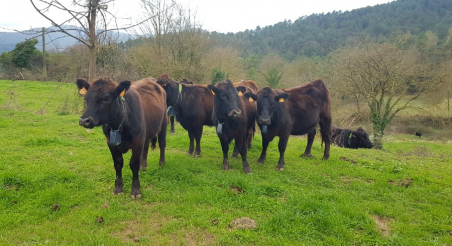
Virginia Peña has spent eight years at the helm of Ramaderia El Cingle, an organically certified livestock farm in Vallcebre (Berguedà). She raises forty-nine Limousin cows that graze freely across the mountain and sells a meat that is, above all else, a taste of the land. We spoke with her to mark International Women's Day, to hear her story and to discover the Parc Regional del Prepirineu Català (Prepicat), an agricultural space created in 2022 with the technical and financial support of the Barcelona Provincial Council.
At 1,000 metres above sea level, Virginia's cows graze peacefully beside a greenish pond while a raven calls from the rocky escarpment of Vallcebre. This farmer, originally from Guardiola de Berguedà, approaches her animals with a curious, unhurried detour — a sign of the deep respect she holds for them. She wastes no time in warning us: "My cows have a bit of a temper. They've had me running! They're well-behaved now, but they used to be a handful." When the herd first arrived in these parts, from the Ripollès and the Cerdanya, the cows struggled to settle: they were used to the lowlands.
All of them are female except for one bull, who lows with a hint of grievance. Some have names: the first she bought is called Margarida; there is also Susanna and l'Arisca. "I liked the Limousins straight away, but I've since learnt they're more restless than the brown cattle," she says. Every cow has her own personality, and among themselves they form bonds of friendship and establish hierarchies. If one of their group dies, the others feel the loss. "I could spend hours watching my cows. I love seeing them and keeping an eye on their calves. When you're out in nature, you learn so much — about the weather, about plants and their medicinal properties. From the cows I've learnt to be patient, that not everything needs to be done in a hurry," says Peña.
Patience and hard work are exactly what this shepherdess has needed to keep her farming project going. Launched in 2018 alongside her partner Isaac Reyes — who now works outside the farm — it has been built on a foundation of self-teaching and a shared passion for learning. Virginia, a tall woman with a clear, direct gaze, dreamt of having animals from an early age: "I was always turning over worms, petting dogs, and whenever I could, I'd bring some little creature home," she laughs. One of her dreams was to become a horse trainer — a goal she has already achieved. Another, shared with her partner, was to run a traditional farmhouse. They managed that too, and then some: "We wanted a farmhouse, but things just snowballed. First, we cleared the land. Then came the sheep and goats. And after that, the cows." The sheep and goats were eventually let go, a few years in, given the complexity of mountain grazing and a handful of other complications.
"When I applied for a personal loan to buy the cows, my family thought I'd lost my mind," she recalls. These days, they understand perfectly — her father even comes to lend a hand from time to time. Her partner also helps with the heavier tasks, such as driving the tractor and cutting hay. Everything else, however, is Virginia's domain: a farmer and shepherdess who is a source of pride for the women of the Berguedà, and a lover of good meat and the natural world.
"From the cows I've learnt to be patient, that not everything needs to be done in a hurry» Virginia Peña
A newly created rural park
Ramaderia El Cingle — Virginia's business — takes its name from the barn where the cows shelter in winter, a building she also bought. From there, we look out over the Baells reservoir and as far as the Montserrat massif: a sweeping view from the heart of the Parc Regional del Prepirineu Català (Prepicat). Established in November 2022 as an association of municipalities — Castellar del Riu, Cercs, Fígols and Vallcebre — under the leadership of the Consell Comarcal del Berguedà, the park is a pioneering model of territorial governance in Catalonia, inspired by the French regional park system. It aims to reconcile the conservation of natural values with the economic development of the primary sector and the promotion of responsible tourism. The Diputació de Barcelona is its principal economic and technical partner, having contributed 318,000 euros since the park's creation.
That is the theory, at least. Virginia is a practical woman. The mayor of Fígols told her about the initiative, but she admits that it is still very new to her, and that she has yet to feel any direct impact on her daily life. Even so, she welcomes the idea of having technical, economic and institutional support to promote the primary sector and recognise the ecosystem services that projects like hers provide. "It's important that there are initiatives like this to protect the land and the local economy," she says. In more established parks, she has seen the installation of drinking troughs, new fencing and cattle grids. "They put measures in place so that everything can coexist," she explains, smiling as she notes that the road nearby has recently been resurfaced. A small improvement, perhaps, but one that points in exactly the direction she hopes the Prepicat will take: becoming, for her and for the whole comarca, a tool as practical as it is necessary.
The park covers the Alt Berguedà and is overwhelmingly forested: 96% of its agricultural surface — 17,498 hectares in total — is woodland, while just 3% is cultivated land (523 hectares), with a further 1,210 hectares considered recoverable. Virginia knows this reality well: "There are many areas to recover and many abandoned forests. They need to be managed to prevent fires."
"It's important that there are initiatives like this to protect the land and the local economy" Virginia Peña
Female, farmer, fearless
In this context, Virginia's extensive livestock farming is a strategic activity: it helps maintain the agro-forestry mosaic, prevent wildfires, and sustain a territory that has spent decades grappling with depopulation and the decline of the primary sector. And she is far from alone: within the park, 38% of agricultural landholders are women.
"I know quite a few women in the area who have their own herd, either with a partner or through a cooperative with other women." She feels there are many more than there used to be, and that gives her heart. Close to home, a neighbour runs a dairy sheep flock just down the road. "We help each other out when needed. All farmers, men and women alike, look out for one another." Support networks matter in a sector as vulnerable as this one. In the early days, Virginia joined the Ramaderes de Catalunya collective, a group of women livestock farmers who graze their animals on open land, but she eventually stepped away: membership required maintaining a social media presence, something that sits uneasily with her way of working.
When asked whether she has ever faced discrimination, she is honest: yes, particularly from older farmers of a more traditional mindset. "They found it hard to accept that you were running the herd on your own, and they'd address themselves to my partner instead," she explains. Less and less so, these days. Seeing her manage the bulk of the farm's agricultural and livestock tasks, day in and day out, has gradually set the record straight. She recalls one telling moment: a neighbour called to say there was a great deal of blood on a nearby road. A group of vultures had attacked one of her cows, and Virginia went straight out to check on the injured animal. She didn't hesitate for a second — just as she never hesitates when she has to be alone on the mountain, even at night. It wasn't always that way, she admits. "At first, I was very frightened, partly because I have a terrible sense of direction. Now my fear is zero. There are no dangers here, human or animal. If I come across a wild boar at night, I'm the one who scares it off!" she laughs. In the mountains of Vallcebre, wild boar, roe deer and foxes are all familiar neighbours.
She suddenly recalls the time she was out with her sheep when a group of hunters wounded a boar. Not knowing where the animal had gone, she walked right into the middle of the situation with her flock — and her sheepdog was attacked. "Boars only become aggressive when they feel threatened," she notes.
Life as a shepherdess brings a broad understanding of the many different people who use the mountain. Hunters are one such group, and she gets on well with them. "There's good coexistence. They need to have their wits about them, but they have their place. Wild boars do real damage to the fields. And there are seasons when they pick up diseases that can spread to the cattle," she explains. In fact, she will soon need to vaccinate the entire herd following the spread of a mosquito-borne illness.
“At first, I was afraid of the mountain. But now my fear is zero. There are no dangers here, human or animal. If I come across a wild boar at night, I'm the one who scares it off!» Virginia Peña
Living alongside tourism
Living and working in a rural park in the Pyrenean foothills also means sharing the territory with weekend visitors and holidaymakers. A few kilometres from where Virginia's cows rest, the old mining colony of Sant Corneli stands as a reminder of the area's industrial past. During our interview, a siren sounds: it is a demonstration at the local museum, which commemorates the coal-mining heritage of one of the most important extraction sites in Catalonia, active until the 1990s.
One of the Prepicat's stated goals is to encourage responsible tourism — visits that integrate respectfully into the landscape and strike a balance between enjoyment and care for the natural environment. Virginia has a clear message for visitors: "Please respect the land."
Summer is relatively peaceful: the paths are largely the domain of hikers and cyclists, with whom she has little trouble. Spring is a different matter. Visitors drive their cars onto the fields and, during the grass-growing season, flatten everything in their path. "If you haven't fenced it off, it seems like you can't say a word," she complains. Spring also brings the calving season, and she has more than once seen visitors stop to stare, wide-eyed, at a cow in labour — at precisely the moment when a cow is most likely to charge, fiercely protective of her newborn.
Autumn, however, is her particular nightmare. Mushroom pickers head into the forest with a single-mindedness that she describes as if their lives depended on it, and Virginia can no longer arrive early in the morning. Her working day doesn't begin until the pickers have left. Then she goes around checking the gates and fences and collecting whatever rubbish they have left behind.
She remembers one episode that is both funny and revealing. A mushroom picker decided to park his car in the middle of the herd and, when he returned a few hours later, his vehicle had been transformed: covered in saliva and chewed in several places, the cows had licked it thoroughly, drawn by the potassium compounds the engine releases. An image, she says, that speaks volumes about how disconnected many visitors are from the realities of the natural world.
A meat that makes the land
The beef from Ramaderia El Cingle carries certification from the Catalan Council of Organic Agricultural Production (CCPAE). The cows always graze outdoors, and the calves stay with their mothers for six months before the dealer comes to collect them for fattening and sale. Virginia used to sell directly to customers when she first started, but no longer: it is simply too much work for one person. Even so, she keeps a close ear to the ground about what people think of what she produces. "My customers value my product because it's organic, it contains no antibiotics, and it's healthy. And when they eat my beef, they know they're supporting the land," she says. Recovering that direct sales model is one of her plans for the future.
She is not the only producer who misses having a proper local distribution network. Projects such as Singulars, run by the Fundació Eixarcolant, are designed precisely to fill this gap: building a large-scale distribution network to connect producers, processors and retailers, to make local products more accessible and helping to slow the disappearance of small-scale farming and neighbourhood commerce.
"My customers value my product because it's organic, it contains no antibiotics, and it's healthy. And when they eat my beef, they know they're supporting the land» Virginia Peña
Between tradition and innovation
Virginia enjoys combining traditional husbandry methods with more modern approaches. In the second year of the farm's life, she trialled GPS tracking collars to monitor the cows' whereabouts in real time. "At first, I didn't realise that a cow would stay wherever you leave her. How could I expect her to stay put? There's the electric fence, of course, but I kept wondering — what if they wander off?" As a shepherdess, she prefers to accompany her animals rather than direct them, and over time she has learnt that the cows know the terrain well: when the grazing runs out, they make their own way down the mountain. The collars worked well enough, but there were areas of the escarpment with no signal, and they eventually stopped using them. Occasionally, she still puts one on, particularly when a cow is close to calving: the birth of a calf is too important and too delicate a moment to leave an animal untracked. In areas with a reliable signal, GPS collars are a useful tool for cutting down supervision time and picking up on unusual behaviour within the herd.
The Institute of Agri-Food Research and Technologies (IRTA) has also invited them to take part in a virtual fencing project — an innovative alternative to physical enclosures. The system involves fitting the cows with GPS collars and drawing the grazing zone directly onto a mobile phone map. When an animal approaches the boundary coordinates, the collar activates and emits a distinctive sound to warn her not to go further. If she ignores the warning and presses on, the sound is reinforced by a mild electric pulse — always at a lower intensity than she would receive from a conventional electric wire. The system removes the need for physical fencing and allows farmers to manage their animals remotely from their phones, making the work more efficient without compromising animal welfare.
For now, though, Virginia has yet to take the plunge. She worries that signal coverage will once again prove a problem, and she is particularly concerned that without physical fencing, visitors to the park will feel even freer to stray into her grazing fields. "If they already come in with the electric fence up, imagine what they'd do without one!" she adds.
Free among the cows
After eight years of hard and sustained work, Ramaderia El Cingle is economically viable. The herd and the winter barn are both paid off and hers outright. "At the beginning, it was all investment, but now I can say with pride that the cows are mine — not the bank's," says the woman from Berguedà. It was not easy: she endured a heavy snowfall and two severe droughts. "The grass wouldn't grow, and I spent my young farmer's grant on feed. I was carrying water to them in hoses from wherever I could find it."
Before long, she hopes to bring her partner back into the project so that they can both live from it, as they had always imagined. She would hand him the tractor work and the paperwork — the part of the job she most dreads. "The only drawback I see in this trade is the bureaucracy. The rules are written in offices, not in fields. Some things they ask of us make very little sense, like having to tag the calves in their first seven days of life." It is a particularly onerous task when the cows and calves are living freely out in the open, as hers do. "I'd love it if a public vet came out to do the tagging," she says. Even then, she thinks it would make far more sense to do it at six months, when the dealer already comes to collect them. But to understand why, you have to know the work from the inside. "The office-based technicians who come out here observe and take notes, but they don't get their hands dirty," she explains.
Despite everything, Virginia Peña says she has a good life. "The work is relentless, but if you love nature, I'd recommend it. I'd do it all again. I feel freer here than in any office, any factory, any bar... Here I have an enormous sense of freedom, and it's wonderful to be outside," she says with a smile. Her mind is already buzzing with new ideas: a breeding project to develop hornless cattle, bringing back a flock of sheep, and eventually returning to direct sales. This shepherdess and farmer from the Pyrenean foothills knows exactly where she is headed, and holds a deep respect for the land where she lives and works. It is a way of life that is also a declaration of love for the Berguedà — the comarca that, for Virginia, has everything.
"the cows are mine, not the bank's" Virginia Peña